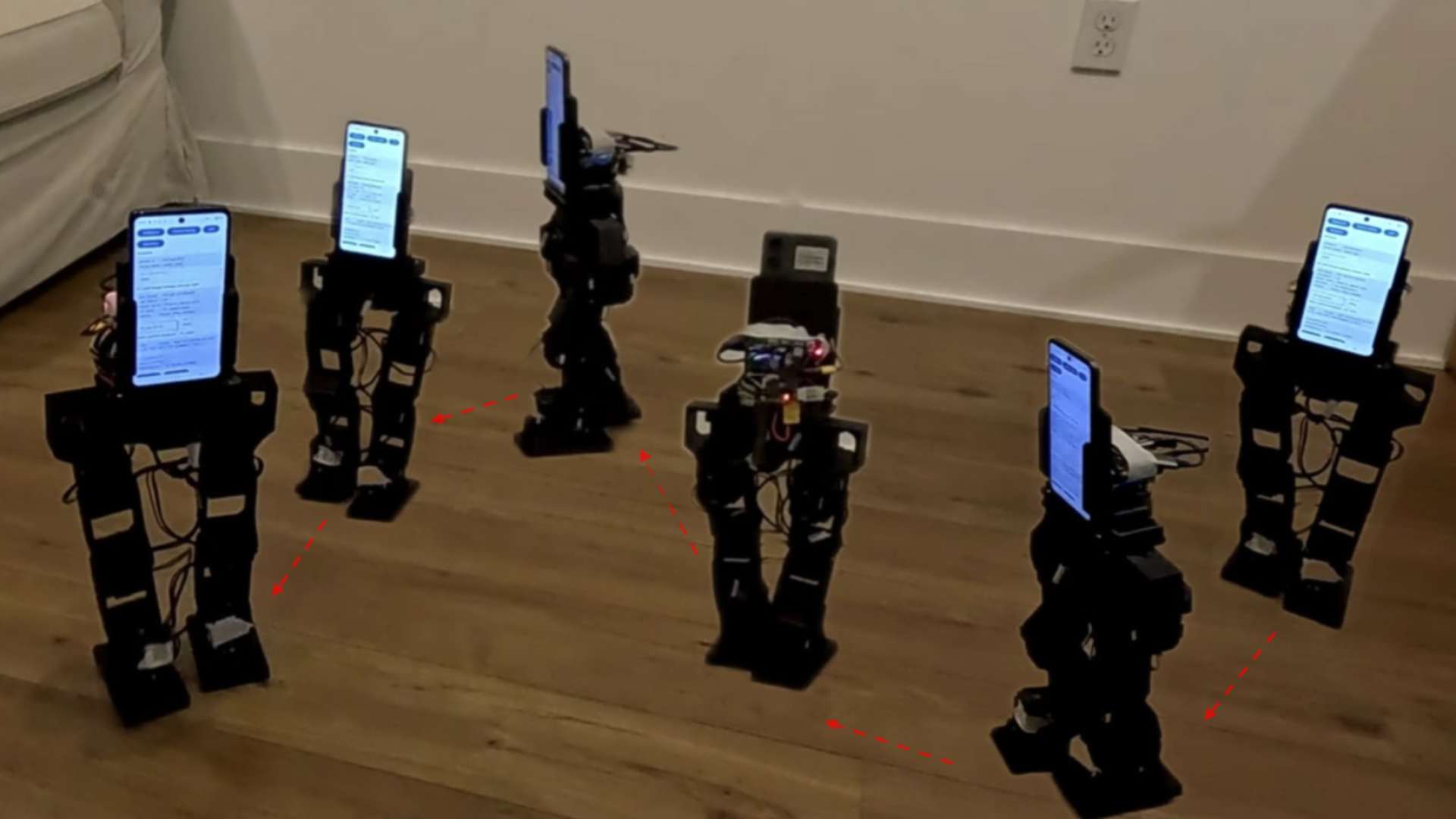
PhoneBot uses an old $50 Android smartphone brain with its cameras as eyes — tech Frankenstein is an open source humanoid robot platform for makers
PhoneBot uses cheap Android smartphones for vision, sensing, and walking control UCLA researchers built a humanoid robot with approximately $400 in hardware Four Android phones handled PhoneBot’s core sensing and computing tasks Researchers at the University of California, Los Angeles (UCLA), have d
<![CDATA[ <article> <ul><li><strong>PhoneBot uses cheap Android smartphones for vision, sensing, and walking control</strong></li><li><strong>UCLA researchers built a humanoid robot with approximately $400 in hardware</strong></li><li><strong>Four Android phones handled PhoneBot’s core sensing and computing tasks</strong></li></ul><p>Researchers at the University of California, Los Angeles (UCLA), have developed PhoneBot, a compact humanoid robot that reuses cheap smartphones for sensing and computing.</p><p>The open source platform costs approximately $400 for its robotic hardware, excluding the phone, making it considerably cheaper than several existing small humanoid research systems.</p><p>PhoneBot stands 483 mm tall, weighs 1.8 kg, and uses 13 servo motors to control its legs and rotating torso during movement.</p><h2 id="old-smartphones-handle-vision-computing-and-robot-control">Old smartphones handle vision, computing and robot control</h2><p>Instead of requiring dedicated cameras, motion sensors and an expensive onboard computer, PhoneBot relies on the smartphone's existing hardware for these functions.</p><p>Its camera tracks people, while the built-in inertial measurement unit supplies motion information that helps the robot maintain balance and execute learned walking movements.</p><p>A separate computer inside the robot handles motor communications, receiving wireless commands from the smartphone over Wi-Fi and translating them into joint movements.</p><p>The robot has six actuated joints per leg, covering the hips, knees, and ankles, alongside another joint that rotates the torso and mounted smartphone.</p><p>This arrangement lets the camera turn toward people without requiring the robot to rotate its entire body, supporting tracking and other vision-based interactions.</p><p>The researchers tested four <a href="https://www.techradar.com/best/best-android-phones">Android phones</a>, including an older Honor 9 released in 2017 and three inexpensive handsets costing approximately $50 to $80.</p><p>All four devices supported the application's core functions, including motion sensing, walking control, visual detection and human interaction, although certain features differed between models.</p><p>The application runs locomotion policies through TensorFlow Lite, while the phone's camera supports person detection and pose estimation, alongside other perception functions.</p><h2 id="training-helps-balance-walking-and-reduces-hardware-costs">Training helps balance walking and reduces hardware costs</h2><p>The team trained PhoneBot's walking controller using reinforcement learning in simulation, rewarding desired movements while penalizing unstable posture and excessive motor loading.</p><p>Early experiments produced uneven walking patterns, with the robot relying disproportionately on one leg, prompting researchers to introduce mirrored training samples.</p><p>This method effectively teaches the controller using corresponding left and right movements, improving gait symmetry without requiring additional simulated physics steps.</p><p>Across five independent training runs, mirrored learning reduced joint-angle symmetry error from 0.254 radians to 0.003 radians during subsequent evaluations.</p><p>The researchers also measured left-right torque imbalance falling from 0.205 to 0.034, while mechanical-power imbalance declined from 0.339 to 0.040.</p><p>Physical demonstrations included walking, recovering from a face-down position, and directing the smartphone camera toward people without continuously turning the robot's feet.</p><p>PhoneBot remains limited by its low-powered servos, which restrict the weight it can carry and the dynamic movements it can perform reliably.</p><p>Its current walking controller was trained on flat ground, while the platform lacks arms for manipulating objects, leaving uneven-terrain mobility unresolved.</p><p>This is an open-source project so researchers can reproduce the platform, modify its components, and investigate smartphone-based robotics.</p><p>The research is currently <a href="https://arxiv.org/html/2610.08737v1" target="_blank" rel="nofollow">published on arXiv</a>, an online repository where researchers share scientific papers before or alongside formal peer-reviewed publication.</p><figure class="van-image-figure inline-layout" data-bordeaux-image-check ><div class='image-full-width-wrapper'><div class='image-widthsetter' style="max-width:676px;"><p class="vanilla-image-block" style="padding-top:31.51%;"><img id="diM9tpwF2Lz85R8q85CT78" name="tr-g_news" alt="Google logo on a black background next to text reading 'Click to follow TechRadar'" src="https://cdn.mos.cms.futurecdn.net/diM9tpwF2Lz85R8q85CT78-1920-80.jpg" mos="" align="middle" fullscreen="" width="676" height="213" attribution="" endorsement="" class="inline"></p></div></div></figure> </article> ]]>
Read the full article on TechRadar
Read Full Article →