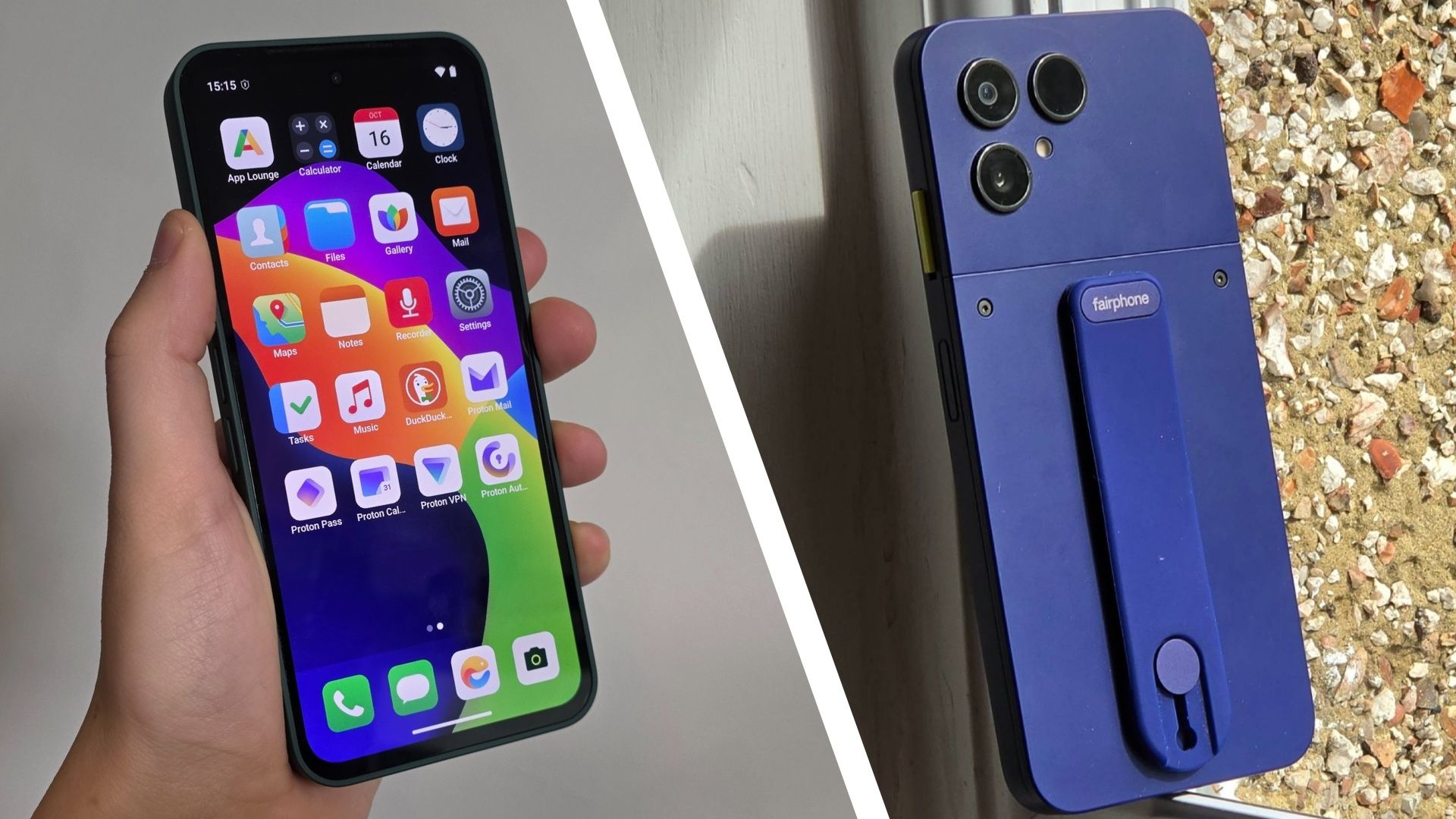
I’m sick of Google running my life, but the /e/OS Fairphone wasn't the de-Googled solution I needed
I don’t know what I’d do without Google. I rely on its search engine for answers to all my questions; I’m writing this article up using Google Docs; its Calendar and Gmail apps help run my life; my phone and tablet are both powered by Android; Chrome is my go-to browser of choice; Google manages my
<![CDATA[ <article> <p>I don’t know what I’d do without Google. </p><p>I rely on its search engine for answers to all my questions; I’m writing this article up using Google Docs; its Calendar and Gmail apps help run my life; my phone and tablet are both powered by Android; Chrome is my go-to browser of choice; Google manages my passwords and is my authenticator app for 2FA, and I watch an ungodly amount of YouTube — I could go on, but you get the picture.</p><p>It’s scary if you sit and think about Google's stranglehold over our daily lives for too long, and so I’ve been desperate to try and de-Google where possible. I was glad, then, when the <a href="https://www.techradar.com/phones/fairphone-6-plus-review">Fairphone 6 Plus</a> came across my desk.</p><p>The standard Fairphone 6 Plus runs Android 16, but the model I’ve been testing for the past month comes preinstalled with /e/OS. This custom mobile OS removes all proprietary Google services, tracking, and built-in Google apps, but is still technically a fork of Android, which means it plays nice with many Android-compatible apps (solving one of the biggest hardware barriers to de-Googling).</p><p>The /e/OS Fairphone 6 Plus is available <a href="https://murena.com/shop/smartphones/brand-new/fairphone-gen-6-plus/" target="_blank">exclusively through Murena</a> for $699.99 / £583 (around AU$1,009); that's slightly more than the standard model, which retails for $649.99 / £569 (roughly AU$1,100).</p><p>Armed with this Google-free phone and a list of apps to install, I was ready to see if I could de-couple from Google once and for all. </p><p>But after one month of trying, I’ve given up.</p><h2 id="what-is-de-googling">What is de-Googling?</h2><figure class="van-image-figure inline-layout" data-bordeaux-image-check="" ><div class='image-full-width-wrapper'><div class='image-widthsetter' style="max-width:2560px;"><p class="vanilla-image-block" style="padding-top:56.25%;"><img id="HdnxkGBR3PNiZZr39TpsMm" name="Fairphone 6 Plus fp app" alt="The Fairphone 6 Plus on a table, showing the Fairphone app." src="https://cdn.mos.cms.futurecdn.net/HdnxkGBR3PNiZZr39TpsMm-1920-80.jpg" mos="" align="middle" fullscreen="" width="2560" height="1440" attribution="" endorsement="" class="inline" /></p></div></div><figcaption itemprop="caption description" class=" inline-layout"><span class="caption-text">The Fairphone 6 Plus is available in a de-Googled /e/OS confuguration </span><span class="credit" itemprop="copyrightHolder">(Image credit: Future)</span></figcaption></figure><p>This steadily growing trend is, as the name suggests, an approach to choosing software and hardware that's devoid of Google’s interference — specifically, de-Googling involves choosing options that have stronger privacy protections for users and less data-tracking services.</p><p>But this isn't just a matter of hopping over to Apple's iOS ecosystem and calling it a day (iPhones, of course, can access almost all Google services). It’s about maximizing privacy in a way that doesn't lock you into a walled garden. For some, de-Googling is also about de-Americanizing — that is, finding hardware and software produced outside of the United States.</p><p>Especially in the wake of the <a href="https://www.state.gov/releases/office-of-the-spokesman/2026/10/imposing-sanctions-on-the-international-criminal-court" target="_blank">US government sanctioning International Criminal Court (ICC) lawyers</a>, which left them unable to access essential online services, and previous efforts to <a href="https://www.reuters.com/technology/us-blocks-foreign-access-anthropics-most-advanced-ai-models-axios-reports-2026-06-13/" target="_blank">ban non-US citizens from accessing the top-tier AI models,</a> it's understandable that some people want to find tech alternatives produced either in their home region or by more stable allies.</p><figure class="van-image-figure inline-layout" data-bordeaux-image-check="" ><div class='image-full-width-wrapper'><div class='image-widthsetter' style="max-width:2560px;"><p class="vanilla-image-block" style="padding-top:56.29%;"><img id="LDYDNCagNLAHM4xGPpy6xH" name="20261016_151652" alt="The Fairphone 6 in green running /e/ OS" src="https://cdn.mos.cms.futurecdn.net/LDYDNCagNLAHM4xGPpy6xH-1920-80.jpg" mos="" align="middle" fullscreen="" width="2560" height="1441" attribution="" endorsement="" class="inline" /></p></div></div><figcaption itemprop="caption description" class=" inline-layout"><span class="caption-text">The Fairphone 6 Plus in Forest Green </span><span class="credit" itemprop="copyrightHolder">(Image credit: Future)</span></figcaption></figure><p>In my case, I used the Fairphone 6 Plus as my day-to-day smartphone, swapped my default search engine to DuckDuckGo, and installed services like Proton to manage my mail.</p><p>Instantly, I was glad to be able to access the /e/OS and platforms like its App Lounge (its built-in app store) without a login, which kept my activity anonymous to some extent. </p><p>I also liked the neat Advanced Privacy widget, which not only lets you block in-app trackers, hide your IP address, and disguise your location on the fly, but also includes a neat graphic showing how many data leaks you've been shielded from over the last 30 days. It gamifies the experience of de-Googling in a fun way.</p><figure class="van-image-figure inline-layout" data-bordeaux-image-check="" ><div class='image-full-width-wrapper'><div class='image-widthsetter' style="max-width:1304px;"><p class="vanilla-image-block" style="padding-top:56.29%;"><img id="gW3v7PaTYZ2ahmtYk96zX5" name="Image-1920-X-1080-1536x864 (1)" alt="A graphic showing the Advanced Privacy feature in /e/OS" src="https://cdn.mos.cms.futurecdn.net/gW3v7PaTYZ2ahmtYk96zX5-1920-80.jpg" mos="" align="middle" fullscreen="" width="1304" height="734" attribution="" endorsement="" class="inline" /></p></div></div><figcaption itemprop="caption description" class=" inline-layout"><span class="caption-text">The Advanced Privacy widget in /e/OS </span><span class="credit" itemprop="copyrightHolder">(Image credit: Murena)</span></figcaption></figure><p>And while Proton offers paid tiers, I was able to trial its encrypted mail service with a free account, keeping my costs just as low as they were before I switched from my previous Android phone (albeit with a more limited service).</p><p>But for all of these early wins, I started to rub up against the more frustrating realities of de-Googling just as quickly.</p><p>/e/OS lacks some must-have Android optimizations — even simple ones, like the option to arrange apps how you want across pages (instead, it takes the Apple approach of apps automatically filling up pages; you can’t create gaps or custom arrangements beyond folders and reordering them).</p><p>Others on <a href="https://www.reddit.com/r/fairphone/comments/1p7zq5g/switched_to_eos_this_summer_and_now_im_over_it_am/" target="_blank">Reddit</a> have also flagged the jankiness of the aforementioned App Lounge and the difficulty in finding navigation apps comparable to Google Maps. I don't live in a major city, so this hasn't been a big red flag for me, but it's true that most Google Maps alternatives lack the coverage and public transport integration to be relied upon.</p><p>Plus, while you can use a free version of services like Proton (like I did), I’d need to pay $12.99 / £10.39 / AU$20.79 a month (or equivalent to $9.99 / £7.99 / AU$15.99 if billed annually) for the experience I got from Google for free, which does add up at a time when costs are rising, and I’d ideally be tightening my purse strings. Remember, too, that this is not a cheap phone.</p><figure class="van-image-figure inline-layout" data-bordeaux-image-check="" ><div class='image-full-width-wrapper'><div class='image-widthsetter' style="max-width:3739px;"><p class="vanilla-image-block" style="padding-top:56.27%;"><img id="JCfitUY7XQtpZ2UGt4enwe" name="20260812_151707 (1)" alt="The Fairphone Gen 6 Plus resting on a black table" src="https://cdn.mos.cms.futurecdn.net/JCfitUY7XQtpZ2UGt4enwe-1920-80.jpg" mos="" align="middle" fullscreen="" width="3739" height="2104" attribution="" endorsement="" class="" /></p></div></div><figcaption itemprop="caption description" class=" inline-layout"><span class="caption-text">The Fairphone 6 Plus is a modular, easily repairable smartphone </span><span class="credit" itemprop="copyrightHolder">(Image credit: Future)</span></figcaption></figure><p>My frustrations also went beyond the general chore of untangling Google from my life.</p><p>I butted up against issues with the Fairphone 6 Plus specifically — its sluggish chipset and good-but-not-great cameras left me wanting to go back to my Android-powered <a href="https://www.techradar.com/phones/samsung-galaxy-phones/samsung-galaxy-z-fold-8-ultra-review">Samsung Galaxy Z Fold 8 Ultra</a> on several occasions.</p><p>I do appreciate the Fairphone's modular, eco-friendly construction, and in our <a href="https://www.techradar.com/phones/fairphone-6-plus-review">Fairphone 6 Plus review</a>, we noted that its Snapdragon 7s Gen 4 chipset "starts sluggishly" before finding its feet in general use.</p><p>I'm also lucky enough to be able to test the <a href="https://www.techradar.com/best/best-android-phones">best Android phones</a> (like the Galaxy Z Fold 8 Ultra) on a regular basis, so I've perhaps been spoiled by their flagship-level performance straight out of the box.</p><p>You may, therefore, not encounter the same hardware frustrations, but trying to de-Google on the Fairphone 6 Plus felt like a double-whammy of difficulty.</p><h2 id="in-for-a-penny">In for a penny…</h2><p>The problem with de-Googling is that it’s full of friction points. And I’ve found that when it comes to tackling that friction, people are very binary — they either want next to none, or, if they’re willing to accept some, they’d also be willing to accept a lot to make their privacy-focused tech dreams a reality.</p><p>That is to say, if people want to go the proper de-Googling route — and my 'people', I mean the folks willing to put in the effort to find the best app alternatives, and change out their hardware — they are also likely willing (and have the technical confidence) to take the step of installing <a href="https://www.techradar.com/phones/android/its-without-a-doubt-one-of-the-least-detrimental-privacy-focused-solutions-to-your-mobile-experience-i-spent-a-month-testing-grapheneos-and-it-almost-made-me-ditch-my-android-phone-entirely">GrapheneOS on a Google Pixel</a> phone.</p><p>The GrapheneOS/Pixel combination still has its drawbacks, but its privacy features are more robust than those you'll find in /e/OS, and newer Pixel models like the <a href="https://www.techradar.com/phones/google-pixel-phones/google-pixel-10-pro-review">Pixel 10 Pro</a> and <a href="https://www.techradar.com/phones/google-pixel-phones/google-pixel-10a-review">Pixel 10a</a> edge out the Fairphone 6 Plus in terms of hardware (which, crucially, would be the only Google involvement in this solution).</p><figure class="van-image-figure inline-layout" data-bordeaux-image-check="" ><div class='image-full-width-wrapper'><div class='image-widthsetter' style="max-width:2000px;"><p class="vanilla-image-block" style="padding-top:56.25%;"><img id="ztWRm9BkQraAjKP6vJgVCg" name="GrapheneOS hands on Pixel 8 Pro" alt="GrapheneOS showing on a Pixel 8 Pro" src="https://cdn.mos.cms.futurecdn.net/ztWRm9BkQraAjKP6vJgVCg-1920-80.jpg" mos="" align="middle" fullscreen="" width="2000" height="1125" attribution="" endorsement="" class="inline" /></p></div></div><figcaption itemprop="caption description" class=" inline-layout"><span class="caption-text">GrapheneOS is a free, open-source operating system focused on privacy and security </span><span class="credit" itemprop="copyrightHolder">(Image credit: Future // Rob Dunne)</span></figcaption></figure><p>Meanwhile, anyone wanting to take the easy route could just switch to Apple. </p><p>The Cupertino company's privacy promises are bold (even following its push into AI), and while picking up an iPhone wouldn't technically be de-Googling in purists' eyes, iPhones are slightly better options than regular Android phones for the mildly privacy-conscious.</p><p>That leaves the /e/OS Fairphone 6 Plus caught between two paths. </p><p>Its privacy features are great, and again, Fairphone deserves credit for offering a truly sustainable smartphone solution. But as someone who was genuinely excited to try to de-Google, I'm not sure whether the trade-offs in both software convenience and hardware quality are worth the hassle. </p><p>Still, with some tweaks made to /e/OS and a more flagship-level Fairphone, I'd be willing to try again.</p> </article> ]]>
Read the full article on TechRadar
Read Full Article →