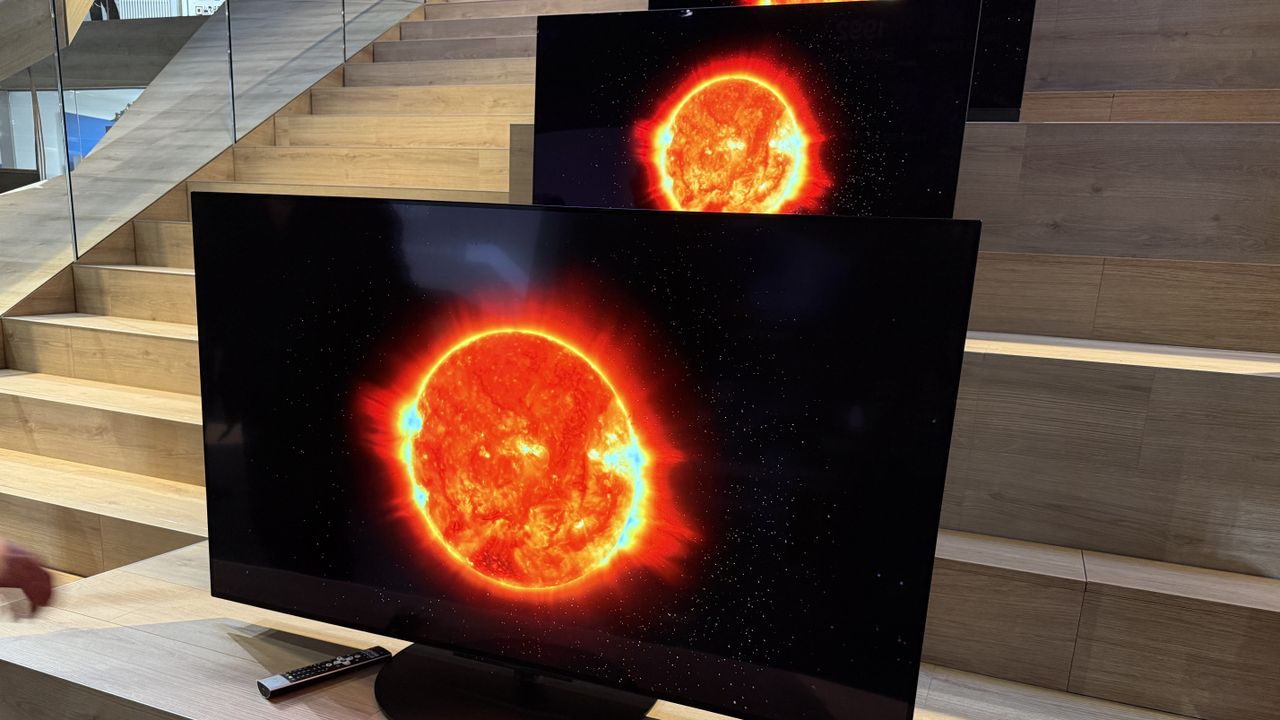
Great news for cheap OLED TVs and monitors: LG's new '2-stack' tech should cost less to make and be more energy efficient than its recent 'OLED SE' panel
New panel has two-stack structure with redesigned emissive layers The result is much better color reproduction and good brightness It's likely to succeed OLED SE, which is in entry-level 2026 TVs LG Display has developed a simpler kind of OLED panel that should deliver a better picture and cost less
<![CDATA[ <article> <ul><li><strong>New panel has two-stack structure with redesigned emissive layers</strong></li><li><strong>The result is much better color reproduction and good brightness</strong></li><li><strong>It's likely to succeed OLED SE, which is in entry-level 2026 TVs</strong></li></ul><p>LG Display has developed a simpler kind of OLED panel that should deliver a better picture and cost less to make or buy than the panels in current WOLED TVs.</p><p>Where most WOLED TV panels use a three-stack structure to emit light (or four stacks in the case of some more premium versions), LG Display's new design uses two. That, the firm says, will reduce production costs and improve energy efficiency. And it'll also deliver improved colors.</p><p>The new panel is designed to be used in mid-range OLED TVs and in computer monitors, making it a direct rival for mini-LED. But you can't get it just yet; although the new panel exists, it hasn't entered mass production.</p><figure class="van-image-figure inline-layout" data-bordeaux-image-check ><div class='image-full-width-wrapper'><div class='image-widthsetter' style="max-width:4032px;"><p class="vanilla-image-block" style="padding-top:56.25%;"><img id="XENJCPoZo8DfHiTm8qmgkj" name="LG B6 Elemental" alt="LG B6 OLED TV with Ember and Wade from Elemental on screen. The B6's colors are bold and punchy, shown by the bright oranges and reds of Ember" src="https://cdn.mos.cms.futurecdn.net/XENJCPoZo8DfHiTm8qmgkj.jpg" mos="" align="middle" fullscreen="" width="4032" height="2268" attribution="" endorsement="" class="inline"></p></div></div><figcaption itemprop="caption description" class=" inline-layout"><span class="caption-text">You can expect to see the new two-stack panels in TVs such as the successor to LG's B6 OLED TV. </span><span class="credit" itemprop="copyrightHolder">(Image credit: Disney / Future )</span></figcaption></figure><h2 id="when-two-stacks-can-be-better-than-three">When two stacks can be better than three</h2><p>This isn't the first time LG Display has made two-stack OLED panels: it produced two-stack OLEDs throughout the 2010s, but moved to three- and later four-stack structures to deliver improved picture quality and brightness. However, the more stacks you have, the more complex and expensive your panels become, and improvements in both materials and engineering have enabled LG Display to produce a two-stack design that wasn't possible a decade ago.</p><p>As LG Display explained to the Korean news sites <a href="https://www.thelec.net/news/articleView.html?idxno=12638" target="_blank">The Elec</a> and <a href="https://www.etnews.com/20260731000155" target="_blank">ETNews</a>, reported by <a href="https://www.flatpanelshd.com/news.php?subaction=showfull&id=1785923042" target="_blank">FlatpanelsHD</a>, the two-stack WOLED panel uses a new blue emissive material and replaces the conventional yellow/green emissive layer with separate red and green layers.</p><p>That change enables the panel to deliver more accurate color reproduction, improving BT.2020 color coverage from 76.5% on three-stack panels to 82.5% on the new panel. </p><p>It's slightly brighter at 6500 Kelvin color temperatures, although it's a little less bright than WOLED at higher color temperatures. LG says it delivers wider viewing angles, too.</p><p>Speaking to <a href="https://www.thelec.net/news/articleView.html?idxno=12638" target="_blank">The Elec</a>, an industry source said: "If the next-generation two-stack architecture enters mass production, LG Display will be able to defend its position in the premium segment while expanding into the mid-range TV and monitor markets, where LCD and mini-LED technologies remain dominant."</p><p>As for when that expansion will happen, we don't have a definite timescale just yet: while the new panels are clearly destined for future LG TVs, LG Display hasn't said when it'll be making the panels available to the likes of Samsung, Sony, Philips and Panasonic. </p><p>For this year's affordable OLEDs, the key panel technology is <a href="https://www.techradar.com/televisions/the-oled-tv-vs-mini-led-battle-is-about-to-really-heat-up-as-lg-shows-off-new-brighter-and-cheaper-oled-panels-ready-for-this-years-tvs">OLED SE</a>, which is the panel used in models such as the 2026 <a href="https://www.techradar.com/televisions/i-saw-the-first-oled-tv-with-lgs-new-gen-cheaper-panel-and-it-looks-like-a-nice-upgrade-but-heres-the-fine-print">Panasonic Z86C (Z85C in Europe)</a>. That's brighter than previous entry-level OLEDs, but the potential downside is that the panel can be more reflective. There are various ways manufacturers can address that, but if reflectivity is a problem in your room it's important to read the reviews to find out what (if anything) they've done to reduce it.</p><h2 id="thinking-of-buying-a-new-tv">Thinking of buying a new TV?</h2><p><em>Try our TV size and model finder! You tell it how far you sit from your TV, we'll tell you what size to buy based on viewing angle advice from image quality experts, and we'll recommend our three top TVs at that size for different prices.</em></p><div style="min-height: 250px;"> <div class="kwizly-quiz kwizly-OKl0mX"></div> </div> <script src="https://kwizly.com/embed/OKl0mX.js" async></script> </article> ]]>
Read the full article on TechRadar
Read Full Article →